

Designing the Studio Pad
The Studio Pad took us on quite a design journey, from debates about container design theory to the challenges of creating a minimal stand that's over three feet long. Come behind the scenes and get to know the latest addition to our workspace lineup a little better.
Setting the Stage
The process started in 2015, when we designed our wool desk pad. The idea was to do several things at your desk: protect the surface, define the space like an area rug, and slide around, so that you could use it to organize and move your space depending on your work. It was all about the material, and we landed on 100% Merino wool felt, a classic material that's included in many of our products.
Then in 2018 we kicked off a redesign of our classic mouse pad. The mouse pad was designed in 2014 as part of our first desk collection, and we wanted to modernize and improve the design manufacturability.
Then in 2018 we kicked off a redesign of our classic mouse pad. The mouse pad was designed in 2014 as part of our first desk collection, and we wanted to modernize and improve the design manufacturability.


SEAN KELLY (Lead Designer): Because we design and manufacture so much, you learn and have a natural give and take between product design and manufacturability. The original mouse pad design started presenting hurdles, so we used it as an opportunity to try something new with a full-width aluminum base.
The new mouse pad was a hit, and we loved the process and result. It got us thinking— could we do something similar in a larger size? Could we use the same combinations of materials and bends? The mental seeds were set.
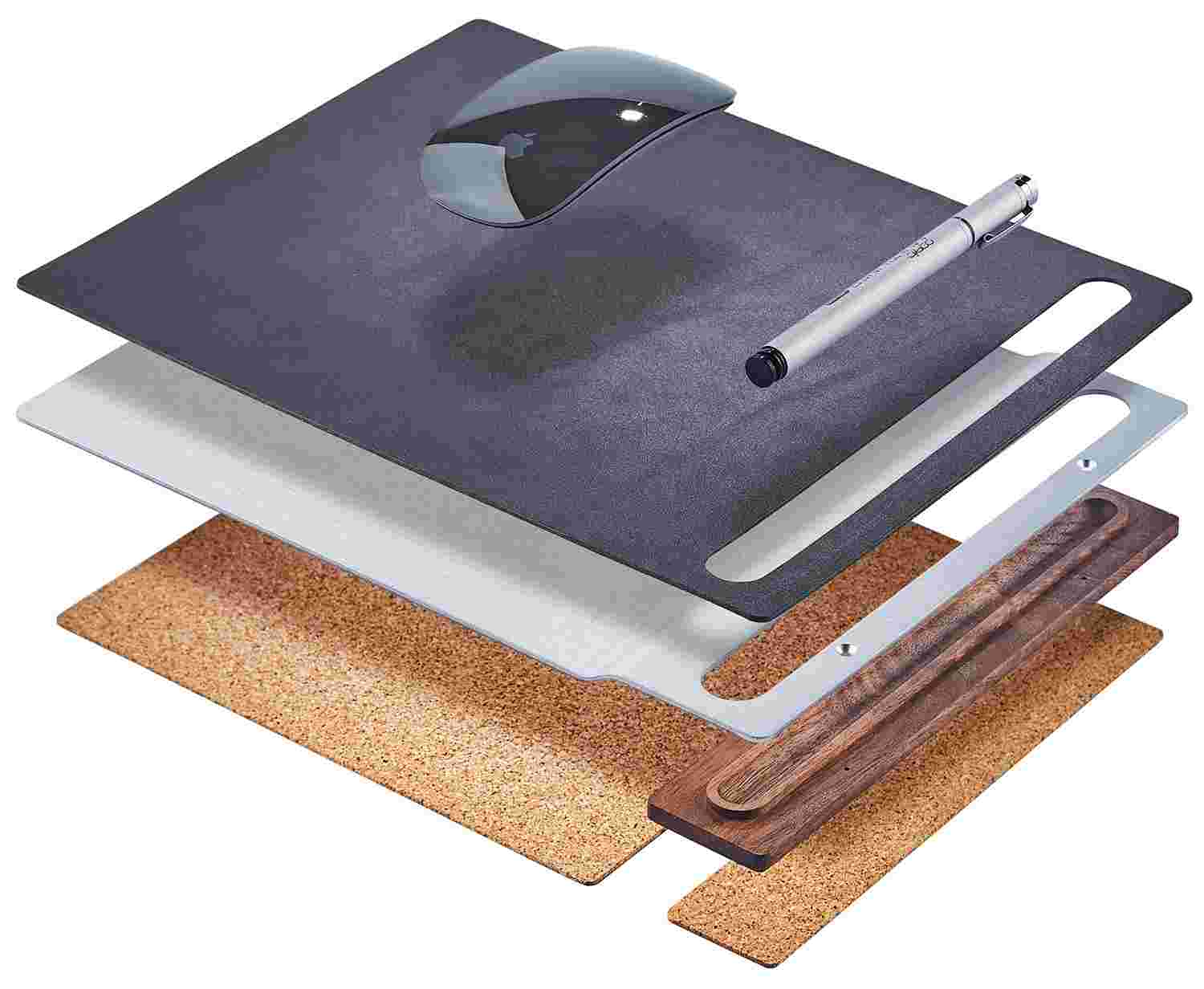

The layered design update to our mouse pad.
Consider the River
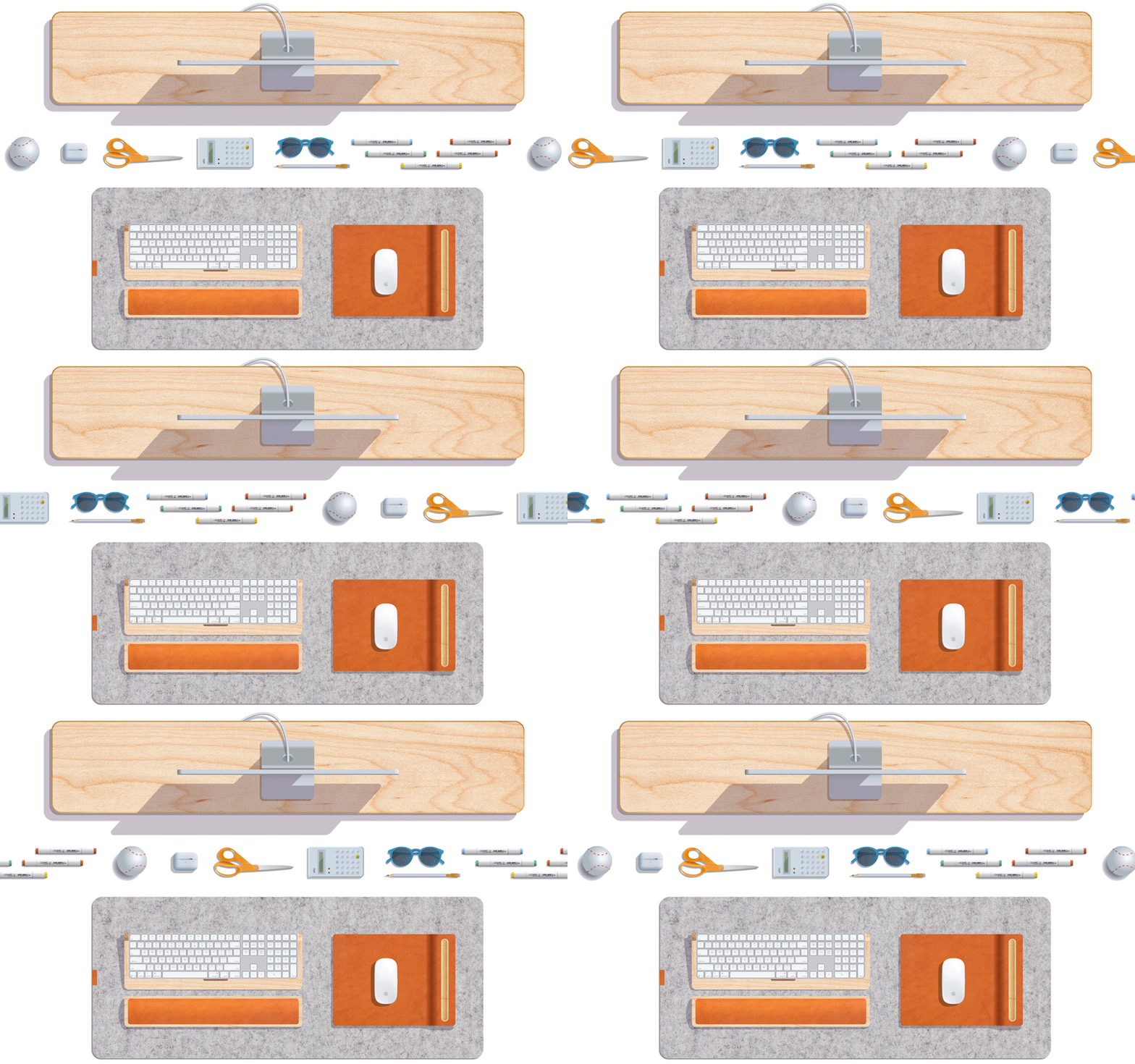
When we designed the Note Taking Kit in 2021, it unlocked something in that space. The main use was note taking, but we found a secret menu of sorts for the Display Rail: we started putting things we found, pictures, or stickers—things that caught our attention and inspired us—into the display rail, not just notes.
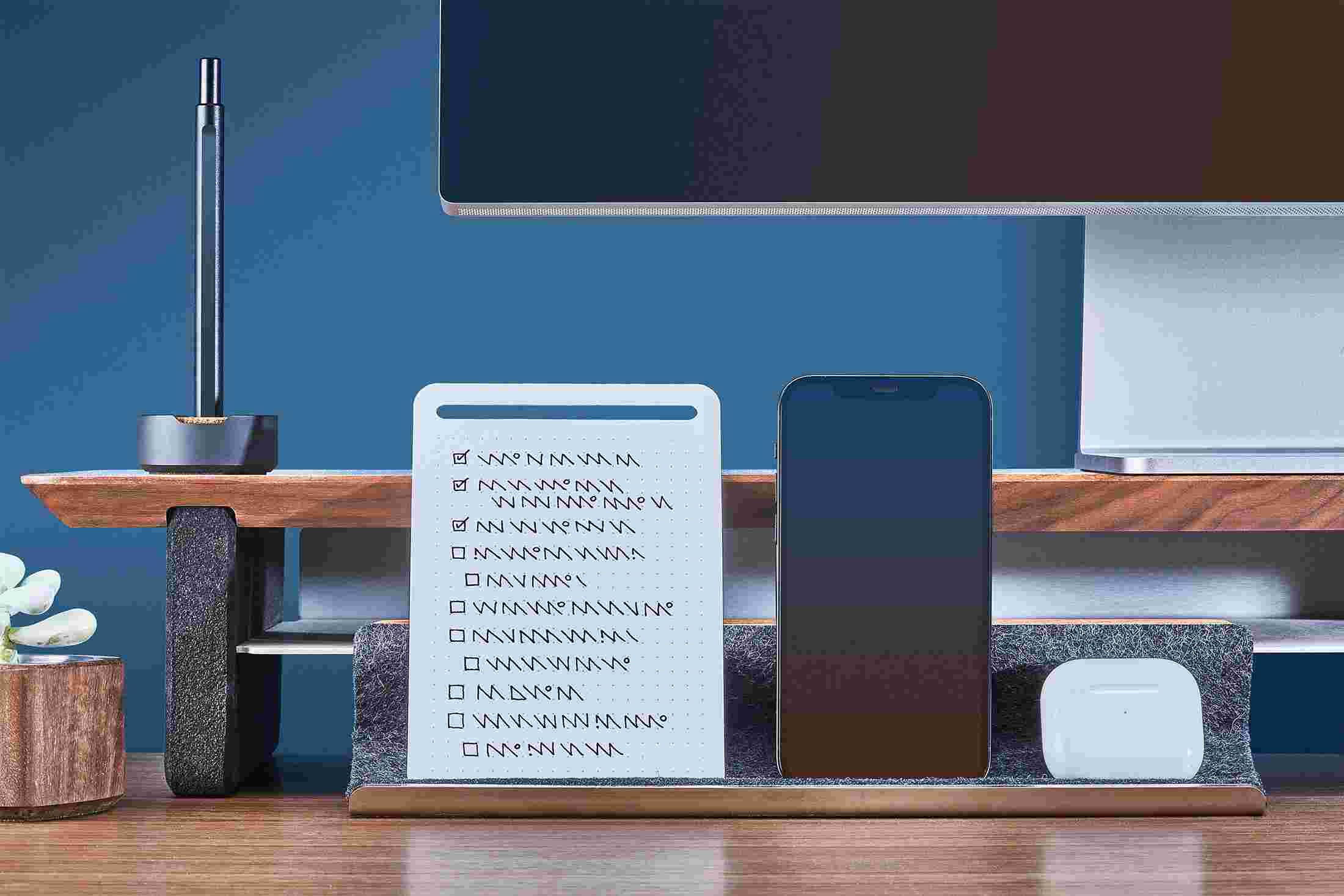

The magical uses beyond note-taking got us dreaming of something bigger. So we started work, inspired by the rigid aluminum base on the mouse pad, the delightful uses we found with the display rail, and this idea of finding the perfect flow in the river. A major challenge, however, was making a product with rich, flexible functions that retained minimalism.
A Stand That Doesn't Look Like It
We always design stands so they look considered with or without any tech on them. With the Studio Pad, it was a considerable challenge, because rather than just one tech item, it needs to handle a wide range of different items (iPad, iPhone, notecards, wallet). And it needs to display and store flexibly, because many of the items are used for a brief period.


KEN TOMITA (Grovemade Co-Founder): With the Studio Pad, the challenge of a subtle stand design was harder to achieve, because it's designed for many different things, and things that come and go regularly. It has to be very minimal in the lines and materials because the literal footprint is so big. It's a delicate balance.
We had to design a stand that offered real functions, had a large footprint, and could flexibly hold many different items for different amounts of time. It meant we really had to get into the details to make sure it all balanced in the end.
Materials and Bends
The two direct products we mentioned—the display rail and the mouse pad—use bent metal and lamination to create function. The display rail uses soft angles and curves to create the ideal viewing height for things placed there. The mouse pad aluminum sweeps up to reveal the added thickness of the pen tray.
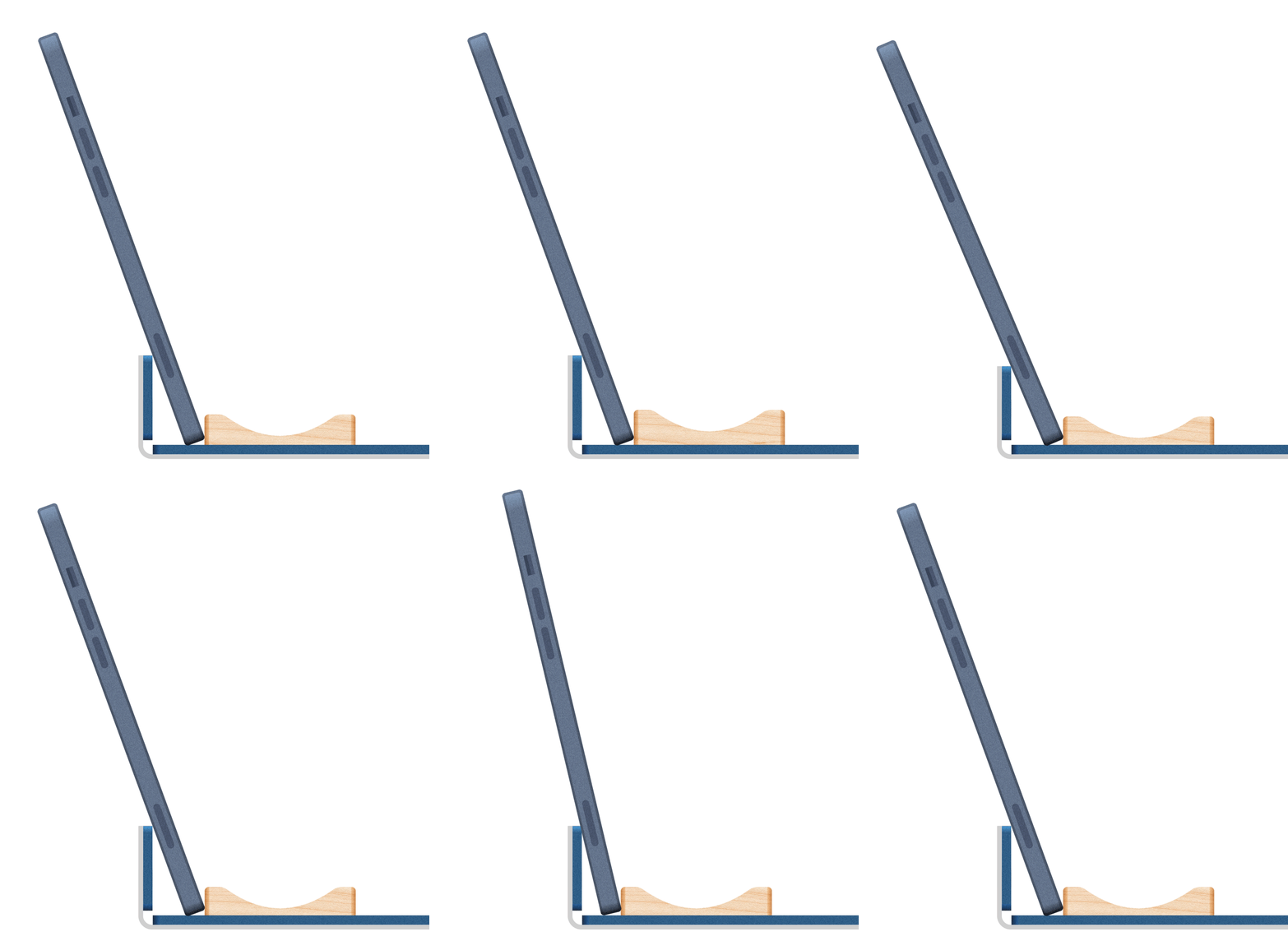
However, the angles in the metal communicate that it should be a stand—meaning it looks more 'stand-like' when nothing is on it. For the Studio Pad, we wanted to disguise that it was a stand. We modeled various bends, and in the end we opted for a 90° bend—very unusual for a stand.
However, the angles in the metal communicate that it should be a stand—meaning it looks more 'stand-like' when nothing is on it. For the Studio Pad, we wanted to disguise that it was a stand. We modeled various bends, and in the end we opted for a 90° bend—very unusual for a stand.
KEN TOMITA: We used a wedge idea to create a flexible stand that was visually simple.
There are three elements to the wedge: the height of the back stop, the height of the wood trough, and the distance between the back and the trough. We were obsessed with keeping the back stop as low as possible. We tried iteration after iteration until we got it right, finding the right height to hold iPads and iPhones stably, as well as paper, notecards, etc, all while staying visually discrete. With that established we started layering on more function.
The Hard Thing about Simplicity
What else could the wood rail do? Storage and organization were the goal—should we machine pockets? Or custom sized holes for specific things? Or keep it general and open?
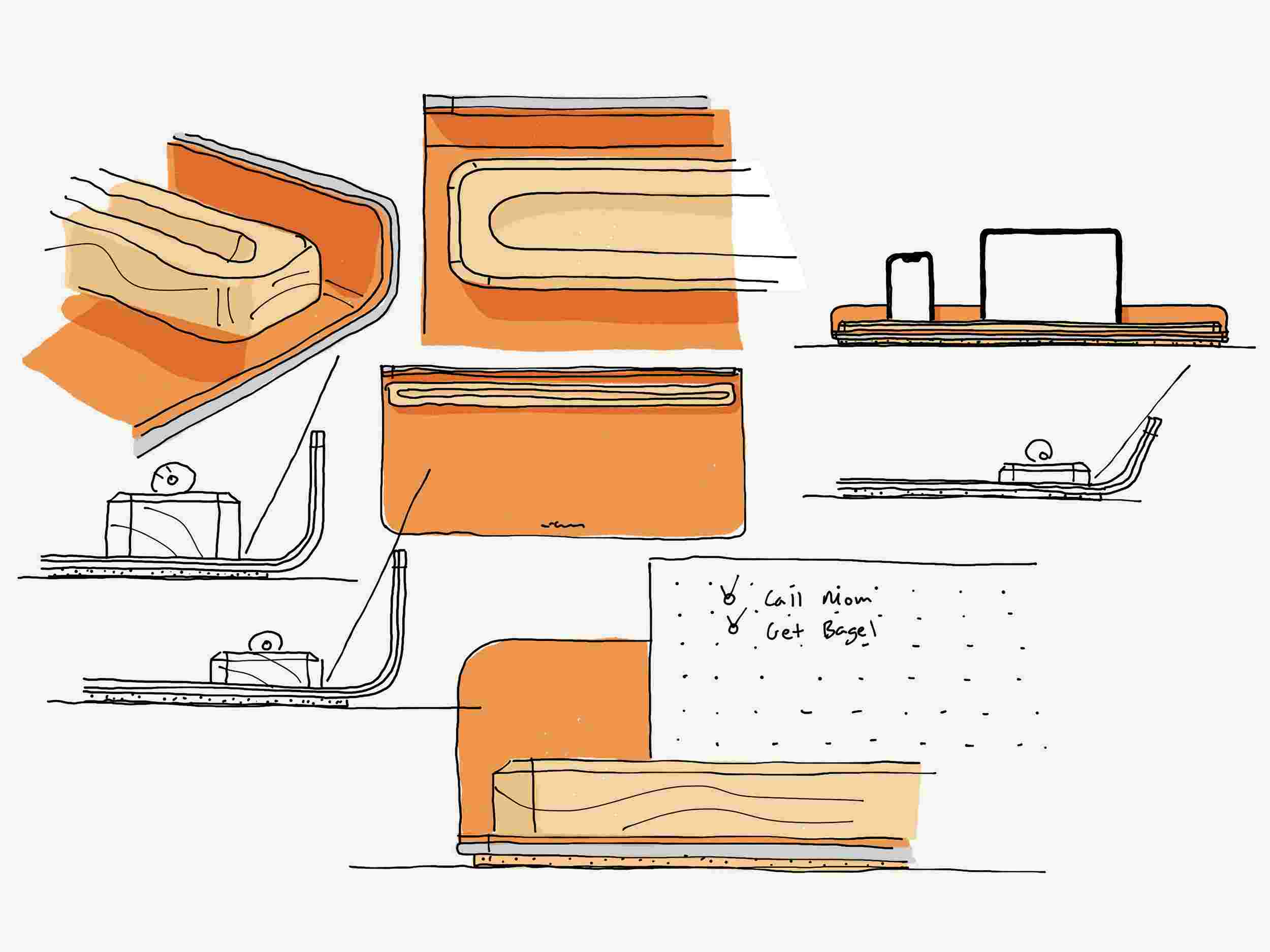

KEN TOMITA: For a while I was insisting we should do something that required a CNC machine. Sometimes I think we need to make something that's difficult to make from a technical standpoint. A thing in organization is to have exact pockets for things—this can look good in photos, but we usually lean towards more general versatility.
Containers define boundaries and edges—they're designed to hold things by restricting space. When something doesn't fit, it becomes awkward, like trying to fit a baseball into a pencil case.
What do you do if you want something that holds both of those things without being awkward? You could have a large container, but then it's the wrong scale for the things in it. We needed to create a container that would be defined just enough to encourage and support a wide range of uses.
What do you do if you want something that holds both of those things without being awkward? You could have a large container, but then it's the wrong scale for the things in it. We needed to create a container that would be defined just enough to encourage and support a wide range of uses.
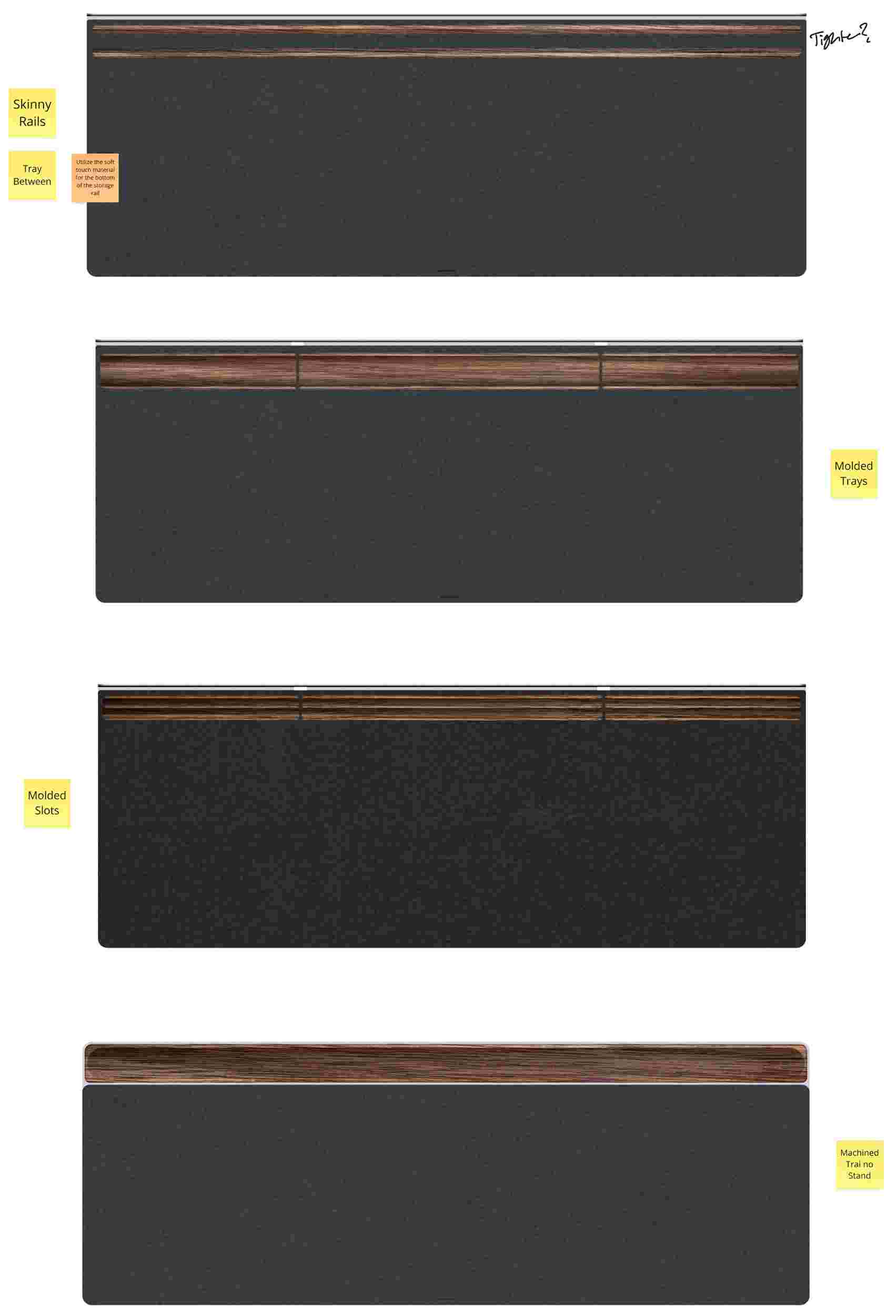

In the end, this led us to develop a continuous sweep through the wood trough.
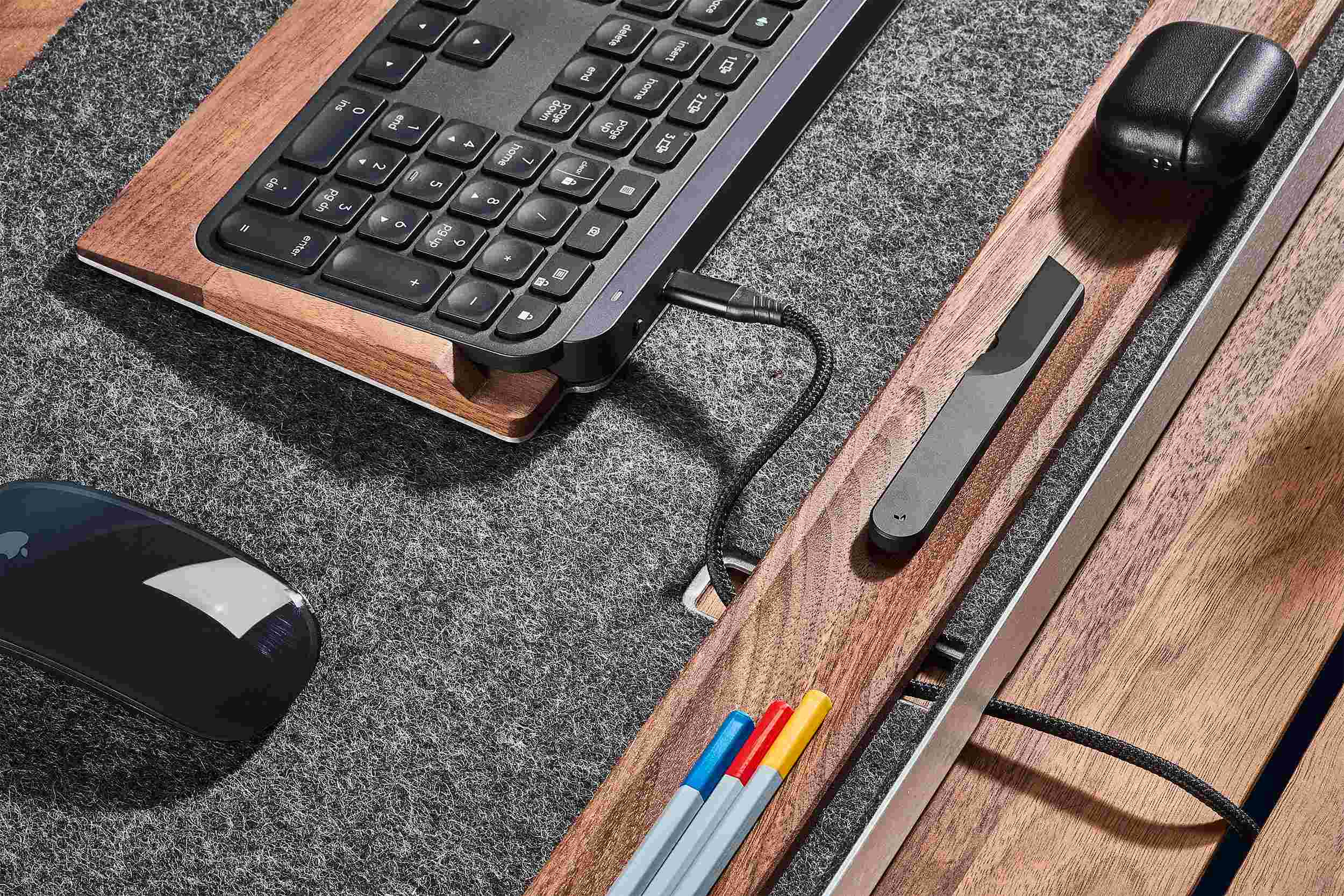
The trough becomes flexible and powerful in a way that defined pockets never will. It can hold a baseball and a pencil with ease. The single, infinite pocket allows for elegant interactions: push something away from you or toward you, and the gentle curve helps it to register in your fingers. And, if you slide something in or out the end, it flows just like a river.
No restrictions, just suggestions.
To complement the trough, we bumped up the technical details of the stacking materials, which opened up the potential cord management underpass.
SEAN KELLY: This idea of a bridge came about where we were using the stack up of materials to create space. The cords were using the underpass of the tunnel to get through.

It's So Heavy
The flexible, infinite trough, the short but effective rail, the cord management underpass—it's all tied together by the weight. The Studio Pad weighs just over five pounds. It will not move, which is part of what makes it so effective. Each user is different, and while moving the desk pad out of the way is great for some, having a workspace that stays put is exactly what others need. You can achieve "stay put" in a few ways: magnets, adhesives, or just really heavy materials.
We love heavy stuff, because it's honest, satisfying and effective. Think of our three pound MagSafe stand that allows one-handed use. Or our MacBook dock, made with burly 14-gauge stainless steel, so you can lift your laptop out and it won't pull the stand off the table. These products don't work if you replace the materials with something lighter. The weight (and size) of the Studio Pad makes the whole thing sing, because it stays put while you work.
We love heavy stuff, because it's honest, satisfying and effective. Think of our three pound MagSafe stand that allows one-handed use. Or our MacBook dock, made with burly 14-gauge stainless steel, so you can lift your laptop out and it won't pull the stand off the table. These products don't work if you replace the materials with something lighter. The weight (and size) of the Studio Pad makes the whole thing sing, because it stays put while you work.
KEN TOMITA: Another advantage of the size and weight is you can make the back stop really small. You can put really heavy things in there and it won't tip, because the product is so massive.
SEAN KELLY: We're using the universal laws of gravity to make our products perform better.
A Product That Invents More Uses
All along, we'd focused on designing the Studio Pad to be versatile, so it could handle variety and change. We based our work on a decade of careful observation and study of workplaces and people in them. So it should have come as no surprise when we uncovered a new use after the design process. Ken had a Grovemade desk in the design space, which he uses as a satellite desk. One day, Nick, our Director of E-Commerce, walked in and noticed that he was using an unorthodox (and very simple) setup—the Studio Pad and an ultrawide monitor on a monitor arm. No desk shelf, no other stands.
KEN TOMITA: It was really exciting to discover that there's this mid-range user—a desk pad is not quite enough, a desk shelf is too much, a Studio Pad is just right.
The Studio Pad worked for a whole section of users that weren't being served. They have stuff, but not as much as our desk shelf users. They might have more minimal workflows, but still needed more function. The Studio Pad handles everything they need and efficiently resolves their problems.
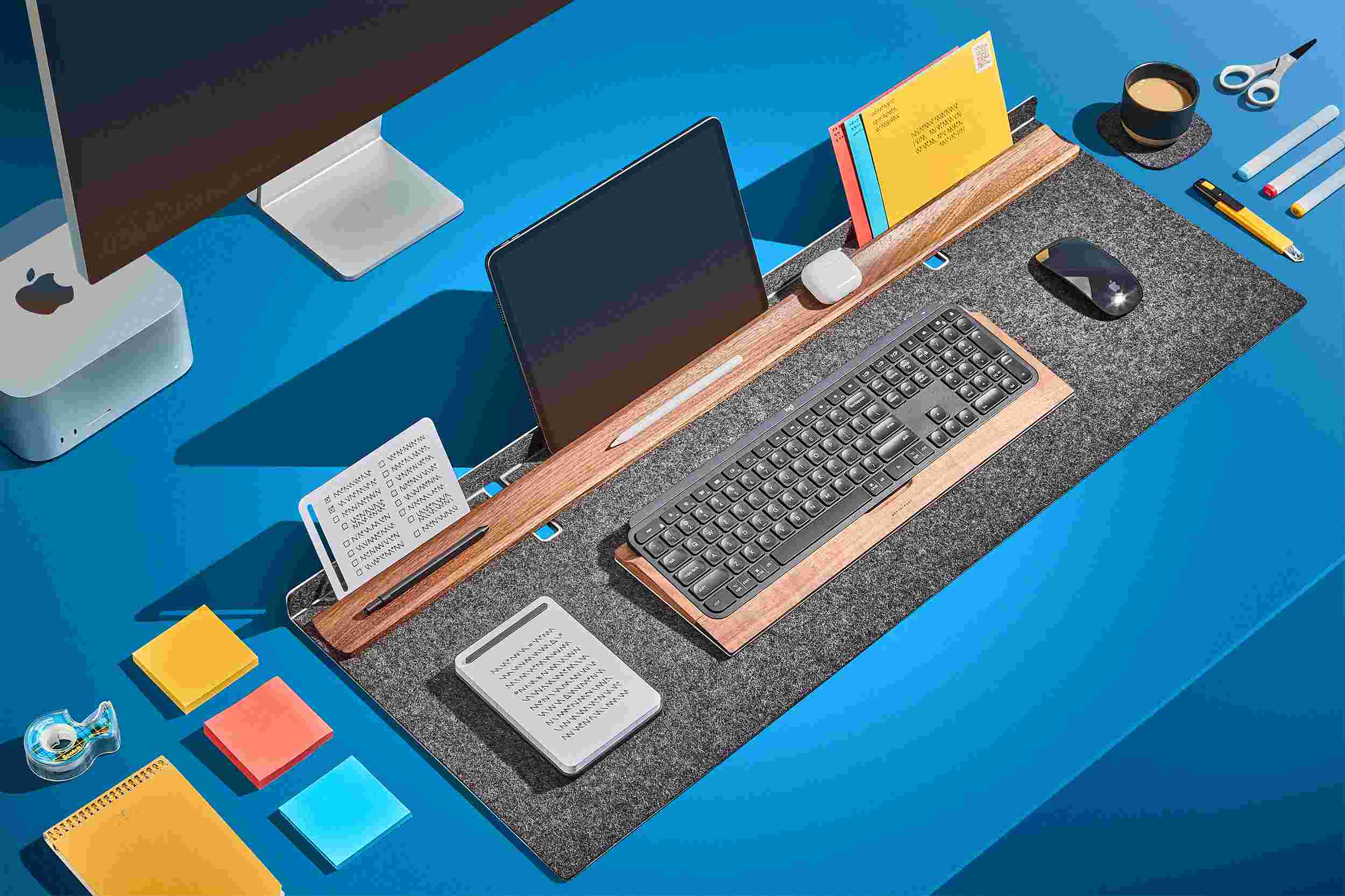

If you have a Studio Pad, we hope you enjoy it and it brings you years of good work.
Wool Felt Studio Pad
100% pure merino wool is the story here—warm, cushioning, all natural. It's a gentle space for typing and scrolling. It pairs with an aluminum chassis for stability, and a hand-finished infinity wood tray that holds your small things. Wool is magical in many ways—in the Studio Pad, its softly heathered appearance means that it will look nearly the same on day one as day 1000.


Matte Studio Pad
The Matte Studio Pad is visibly different—it gives you a minimal look and creates a clean setup. The natural linoleum material resists fingerprints, is a good surface for hand-writing, and is cool and soft to the touch. Laminated to the aluminum chassis for stability, it pairs with the hardwood tray to handle your small items.


